Seoul can learn from Quebec’s climate-conscious building design and Barcelona’s walkable neighborhoods, while Quebec and Catalonia can draw lessons from Seoul’s public transportation and urban renewal, architects attending the Catalonia-Quebec-Korea Architecture Forum say.
As cities face rising temperatures and pressure for denser development, they argued that new housing should go hand in hand with better public spaces and preservation of neighborhood identity.
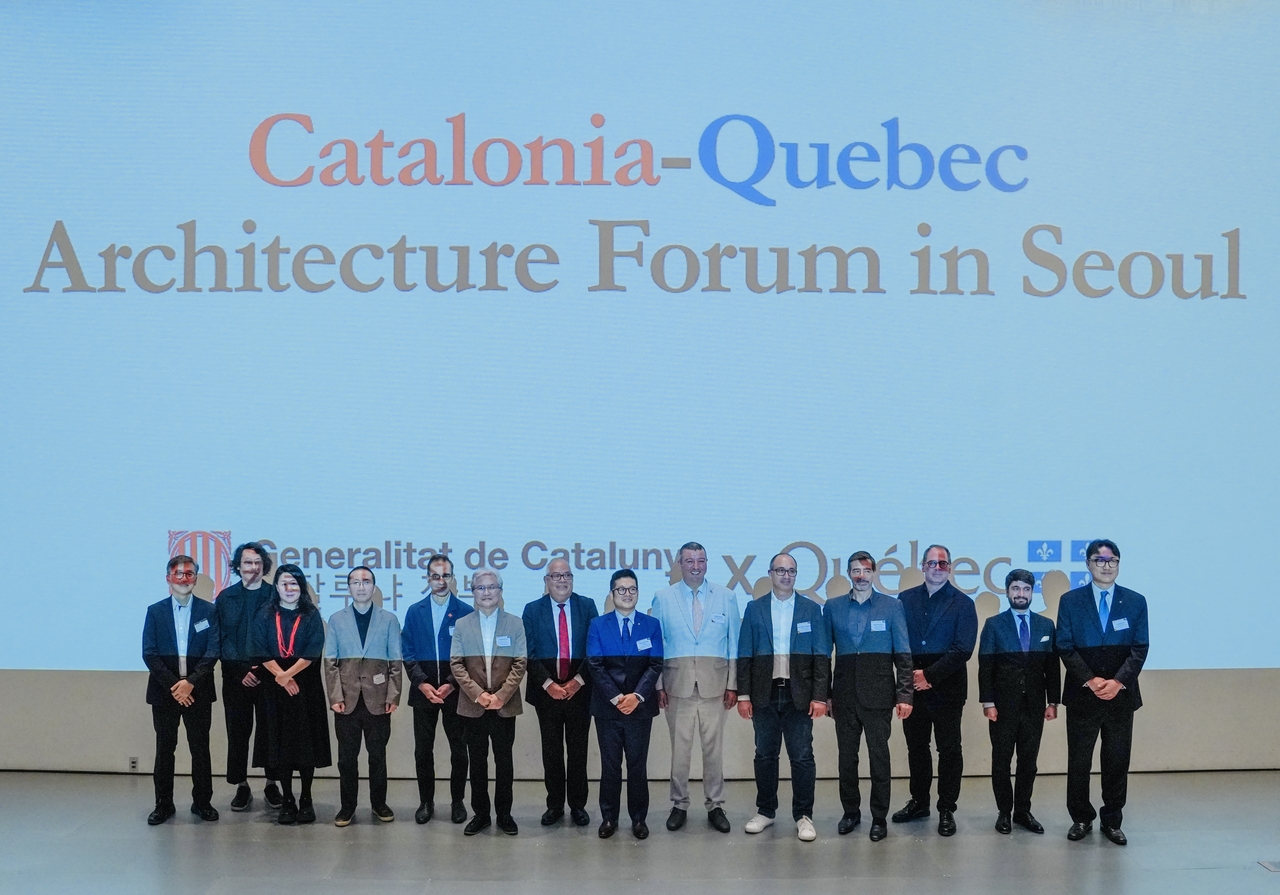
Their comments came at the Catalonia-Quebec-Korea Architecture Forum on Oct. 7 at the Seoul National University Museum of Art.
Titled “Barcelona × Montreal × Seoul: Three Cities, One Dialogue Through Architecture,” the event brought together architects, academics and industry representatives.
Building for a changing climate
Maxime Frappier, president of ACDF Architecture, said the Canadian province’s experience with harsh weather could help Seoul adapt to hotter summers and climate change.
“Our demanding climate has taught us to make every design decision count,” he told The Korea Herald.
He recommended compact building forms, effective insulation and airtight construction to improve energy efficiency, while reconsidering extensive glass facades.
Buildings account for about two-thirds of Seoul’s greenhouse gas emissions, according to the city’s 2024 climate plan.
Frappier also called for varied building heights and forms in large apartment complexes, alongside accessible parks, gardens and public spaces.
“People inhabit more than a home: They belong to a neighborhood and a city,” he said, adding that thoughtful design can preserve sunlight, views and community connections.
Towers should also contribute to street life through their entrances, balconies, materials and sidewalk connections.
Lessons to learn from each other
Frappier said Seoul’s metro and bus networks showed how accessible public transportation could support high-density development, offering lessons for Quebec. Montreal’s expanding cycling infrastructure, meanwhile, could inform Seoul.
He cited Cheonggyecheon as the Seoul project that impressed him most, highlighting its social value as a stream and public space connecting neighborhoods.
Reopened in 2005 after an elevated highway was removed, the restored stream replaced vehicle-focused infrastructure with public space through downtown Seoul.
Marc Zaballa i Camprubi, secretary-general of the Architects’ Association of Catalonia, said Seoul could learn from Barcelona’s Cerda plan without copying its street grid.
“Density must be accompanied by quality of life,” he told The Korea Herald, citing the northeastern Spanish city’s walkable Eixample district. He warned that large-scale redevelopment in Seoul could replace diverse local shops, restaurants and workshops with uniform environments.
For Seoul, the challenge is to increase density without losing the local businesses, public spaces and community ties that give neighborhoods their character.
Zaballa urged Seoul to preserve not only landmarks but also markets, ordinary buildings, small businesses and community activities. He cited the 2015 Sewoon Sangga regeneration plan, which sought to improve pedestrian connections while retaining local manufacturing businesses.
Rather than building more icons, Seoul could develop an “iconic urban model” combining density, climate resilience and technological development with livability and local identity.
He also called for greener public spaces, greater reuse of existing buildings and neighborhood regeneration.
For Seoul, he said, “the interaction between old and new can itself become a source of new architecture.”
The forum also marked the centenary of Antoni Gaudí’s death and featured a session on Korea’s pavilion at Montreal’s Expo 67, according to the Quebec Government Office in Seoul.
sanjaykumar@heraldcorp.com